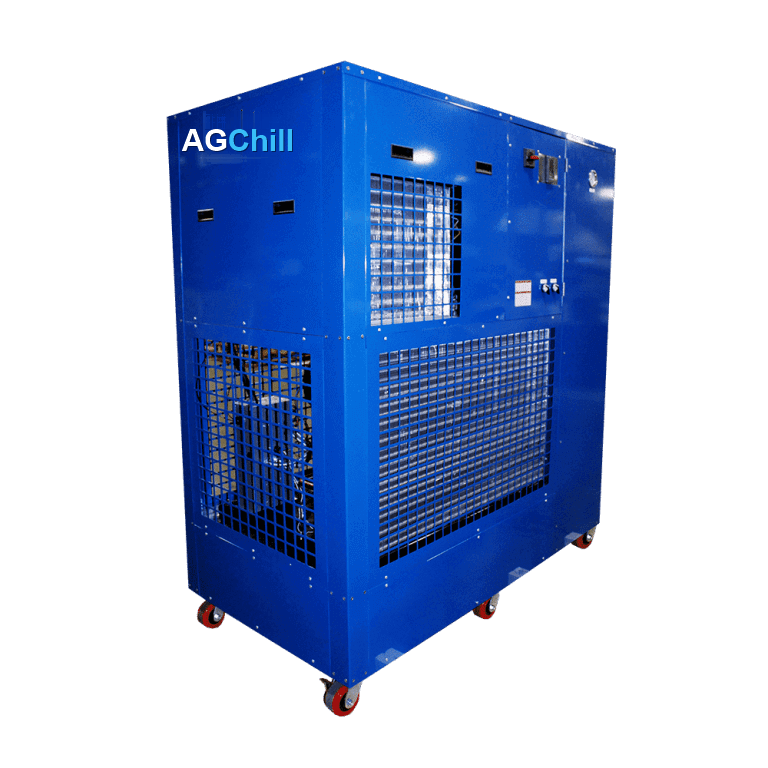
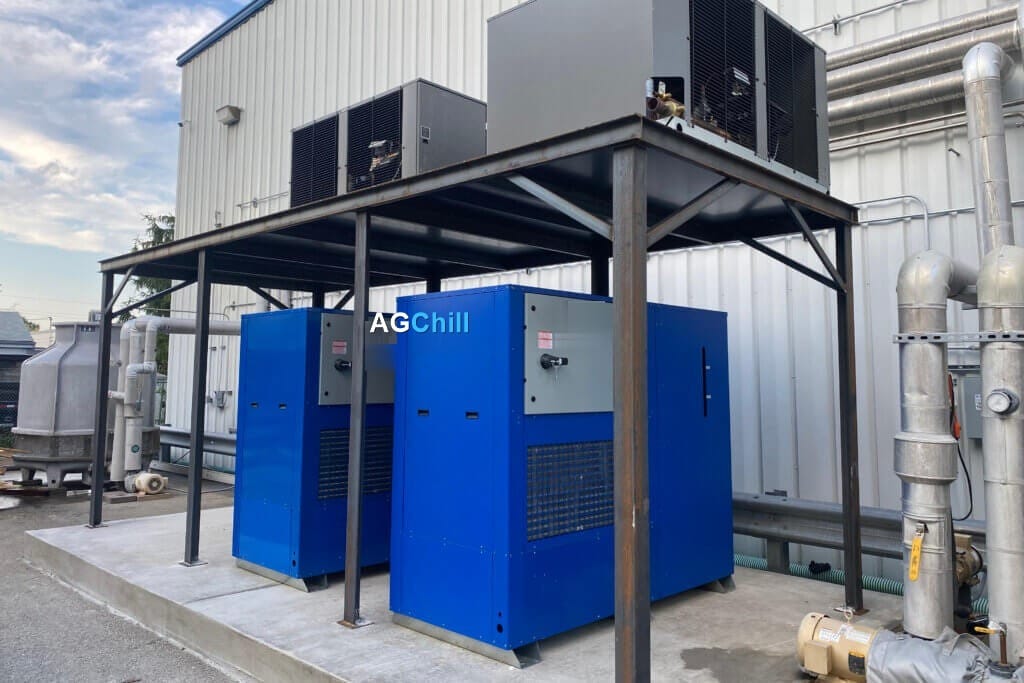
Precision process cooling down to −80°C (−112°F). Engineered for extraction, pharmaceutical, semiconductor, laboratory, food, and more.
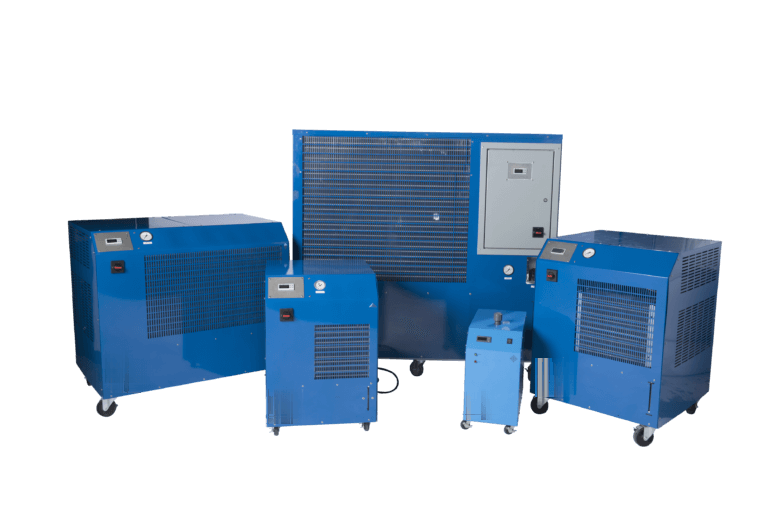
From ½–50 ton process chillers to ultra-low temperature systems down to −80°C, AG Chill helps you specify the right cooling solution — without the guesswork.
Most industrial chiller websites hand you a catalog and say good luck. AG Chill does it differently.
01
Tell Us the Process
Share your flow rate, target temperature, heat load, fluid type, environment, voltage, and application. The more detail, the better the recommendation.
02
We Size the System
We match the chiller, pump, tank, controls, and options to your actual operating conditions — not just a default oversized catalog pick.
03
You Get a Clear Recommendation
No catalog maze. No oversizing by default. No unsupported guesswork. A clear, practical recommendation you can act on.
Chiller Classes
Five Series. Every Temperature.
From standard process cooling to -112°F (-80°C) cascade systems — every series is built around a specific temperature range and application.
Built for Buyers Who Need Answers, Not Just Equipment
Engineering-Led Selection
We evaluate temperature requirements, flow rates, heat load, ambient conditions, and operating constraints — then help you choose accordingly. Not a guess, not a default spec sheet.
Fast, Practical Support
Get clear answers from people who understand industrial cooling applications. No runaround. No endless forms. Tell us what you're cooling and we'll tell you what you need.
Application-Specific Solutions
Systems configured for extraction, pharma, plastics, food processing, beverage, machining, and manufacturing — not repurposed HVAC units passed off as process chillers.
Reliable Industrial Equipment
Durable chiller platforms built for uptime, serviceability, and long-term stable temperature control. Equipment you can actually keep running, not just install and hope for the best.
Chiller Sizing Tool
Not Sure What Size Chiller You Need?
Use the quick selector to start a recommendation. AG Chill can help estimate tonnage, temperature range, fluid type, and system configuration based on your actual process.
Whether you need a quote, have a technical question, or just want to talk through your cooling application — fill out the form and AG Chill will respond within one business day.
Real industrial cooling challenges that a properly sized and configured system addresses.
Botanical Extraction
Extraction Facility — Solvent Instability
Challenge
Solvent temperature was fluctuating during ethanol extraction runs, causing inconsistent yield and requiring repeated process adjustments between batches.
Solution
Ultra-low temperature process chiller package sized to pre-cool ethanol solvent to target −40°C and hold it stable throughout the extraction cycle.
Result
More consistent operating conditions across batches, reduced process time, and easier post-processing.
Brewery
Craft Brewery — Fermentation Temperature Swings
Challenge
Fermentation tank temperatures were drifting by 4–6°F between shifts, affecting flavor profiles and batch consistency during peak production months.
Solution
Properly sized glycol chiller with a correctly designed loop — matching actual tank heat load, glycol concentration, and loop pressure drop.
Result
Stable fermentation temperatures within ±0.5°F. Better batch-to-batch consistency and confidence heading into expanded production.
Plastics Manufacturing
Injection Molding Plant — Cycle Time & Quality
Challenge
Inconsistent mold temperatures were extending cycle times and causing part-quality variation — warping and sink marks in high-volume production runs.
Solution
Dedicated mold cooling chiller package with sufficient flow capacity and temperature stability to support the production line's actual heat removal requirements.
Result
Improved process stability, reduced scrap rate, and shorter cycle times — without changing tooling or process parameters.
Built for Industrial Requirements
Built Around Real Industrial Requirements
½–50T
System capacity range
−80°C
Ultra-low temp systems available
25
Industries served
Air+ Water
Air-cooled & water-cooled options
½ ~ 50 Ton Systems
Ultra-Low Temp Options
Glycol Compatible
Air & Water Cooled
Custom Pump & Tank Packages
Application Engineering
North American Industrial
What Our Customers Say
Trusted by Operators and Engineers Across Industry
Our AG-Chill chillers have been cranking without any issue all summer enduring many hard loaded weeks with temps above 100 outside! We are grateful to be able to rely on the consistent -65F solvent that your system provides.
Josh Lippold
Owner, Timberline CBD
I am honored to be a reference for AG-Optimists and your AG-Chill chillers. I have nothing but good things to say about these chillers and the service you and your team provide!
Brandon Swartzbaugh
Extraction Manager, Abstrax
One of our customers is planning on starting an RSO lab in Colorado. When I heard, I had to recommend you guys since I have seen what an amazing product your chillers produce firsthand.
Valerie Orta
Quality Manager, Labplex
This is the chiller equipment I would specify for outdoor installation at your facility. These guys have it dialed and are working toward some really cool advancements for energy savings as well.
Jef Frick
President, Spherex
From my experience in this industry, AG-Optimists offers much more design support than the others, which is of tremendous value. Their expertise was unique and reassuring.
Russell W. Birch, P.E.
Professional Engineer, IMEG
I really like working with AG-Optimists, their efforts are heroic.
Matthew Penner
Intertek
Buying Guides
Chiller Buying Guides
Practical guides to help you understand what you need before you spec anything.
Compare
Compare All Five Chiller Series
Standard, LT, ELT, SLT, and ULT side by side — minimum temperature, capacity, refrigeration type, and best-fit applications from 40°F down to −112°F.
Everyone asks "how many tons?" first — but the temperature you need is what actually decides which chiller can do the job. Why temperature comes first.
Single-stage, two-stage, and cascade refrigeration explained — and why ultra-low temperatures need a fundamentally different machine, not just a bigger one.
Walk through the key variables — heat load, flow rate, temperature differential, and ambient conditions — and understand how they affect chiller sizing.
What a glycol chiller actually does, how the loop is designed, common sizing mistakes, and how to choose between PG and EG glycol for your application.
Temperature requirements for ethanol, hydrocarbon, and solventless extraction processes — and how to match a chiller to your specific throughput and solvent.
Fermentation cooling loads, cold stabilization requirements, tank jacket sizing, and how to design a glycol system that won't fall short at peak production.
Chiller sizing depends on your heat load (BTU/hr or tons), required temperature differential between supply and return fluid, and flow rate. The quick selector above captures the key inputs — fill it out and we'll calculate an appropriate size for your application. Oversizing and undersizing are both common mistakes; we help you avoid both.
Standard process chillers typically operate from about 20°F to 80°F (−7°C to 27°C). With glycol-based fluids, you can go lower — typically to around −20°F (−29°C). Ultra-low temperature cascade systems can reach −80°C, which is required for some ethanol extraction and pharmaceutical applications. The right range depends entirely on your process.
Air-cooled chillers reject heat to ambient air and are simpler to install — no cooling tower or condenser water system needed. Water-cooled chillers reject heat to a cooling tower or building water loop and are more efficient, especially in high-ambient environments. The decision usually comes down to your facility infrastructure, ambient conditions, and operating cost priorities.
The more you can share the better, but even a rough description helps. Useful starting points: what you're cooling, the fluid type, target supply temperature, approximate flow rate, installation environment (indoor/outdoor), and available power. If you don't know all of these yet, that's okay — we can help work backward from your process requirements.
Yes. Many industrial cooling requirements don't fit a standard catalog product. We can help specify integrated packages with pumps, tanks, controls, heat exchangers, and filtration configured around your specific process — not a generic build you'd need to modify after delivery.
Yes. Glycol chiller systems are one of our core application areas, particularly for breweries, wineries, food processing, and any application where freeze protection is required or where process temperatures fall below 32°F. We help with both propylene glycol (food-safe) and ethylene glycol systems.
Yes. Ultra-low temperature chillers using cascade refrigeration systems can reach −40°C to −80°C and are commonly used in ethanol extraction, pharmaceutical processing, and environmental test chambers. These systems are more complex and more expensive than standard process chillers — we'll help you understand whether you actually need ULT or whether a standard low-temp system will meet your requirements.
For most standard applications, we can provide a recommendation within one business day of receiving your process details. Complex or custom applications may take longer. Use the chiller selector above to get started — the more detail you provide upfront, the faster we can respond with something actionable.
Get Started
Need Help Choosing the Right Chiller?
Tell us what you're cooling. AG Chill will help identify the right temperature range, capacity, fluid type, and system configuration — without the catalog maze.