← All Industries
Aerospace
Aerospace & Defense Chillers
Precision process cooling for wind tunnel testing, hydraulic test rigs, avionics thermal management, and composite manufacturing.
View Recommended Chillers
Precision process cooling for wind tunnel testing, hydraulic test rigs, avionics thermal management, and composite manufacturing.
View Recommended ChillersAerospace manufacturing and testing demands precise thermal management across multiple systems. Wind tunnel testing requires stable coolant circulation to absorb aerodynamic heating without temperature drift; hydraulic systems in flight test rigs generate intense heat from high-pressure actuators; composite manufacturing ovens need tight control to prevent material degradation.
Even a 5°C temperature swing can invalidate aerodynamic data, cause hydraulic fluid viscosity issues, or trigger thermal stress in carbon fiber layup. The chiller is what keeps test data valid and composite parts within spec.
Common process cooling problems in Aerospace and why getting the chiller right matters.
Wind tunnel and hydraulic dynamic tests dump 500+ kW of heat into coolant within seconds of startup. Standard chillers either undershoot or surge — aerospace needs rapid-response capacity that holds setpoint through the spike.
Aerospace specs demand tight filtration and water-content limits in hydraulic coolant. One particle bridge can jam a multi-million-dollar actuator. Chillers must integrate robust filtration most off-the-shelf units lack.
Test stands often cool disparate systems at once — hydraulics, avionics, and composite cure ovens at different setpoints. Space-constrained test cells need compact, flexible chillers, not one oversized central unit.
Our chillers integrate directly with the process equipment that Aerospace and Defense relies on. These are the systems we most often cool — each with its own temperature target, flow, and failure mode we size for.
The chiller holds resin cure temperature so carbon-fiber parts stay in spec.
The chiller drives the cold side of thermal-cycling and altitude simulation.
The chiller pulls heat from high-pressure actuators during flight-test rigs.
The chiller absorbs aerodynamic heating so test data stays valid.
Chiller systems most commonly matched to Aerospace applications.
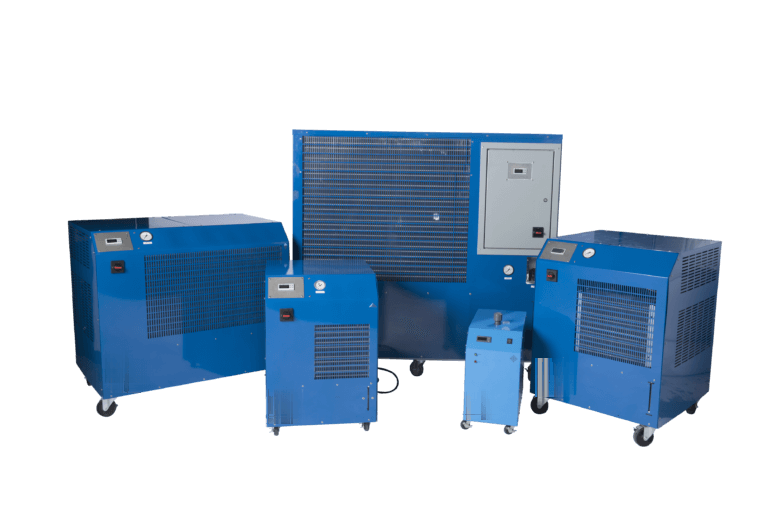
Standard Series
40°F / 4°C
1/3-40 Ton
Stable process cooling for hydraulic test rigs and general aerospace test stand thermal management with fast response to load changes.
Get a QuoteCentral Chiller
45°F / 7°C
10-50 Ton
Centralized cooling for wind tunnel facilities and multi-zone test cells running simultaneous cooling demands across the facility.
Get a Quote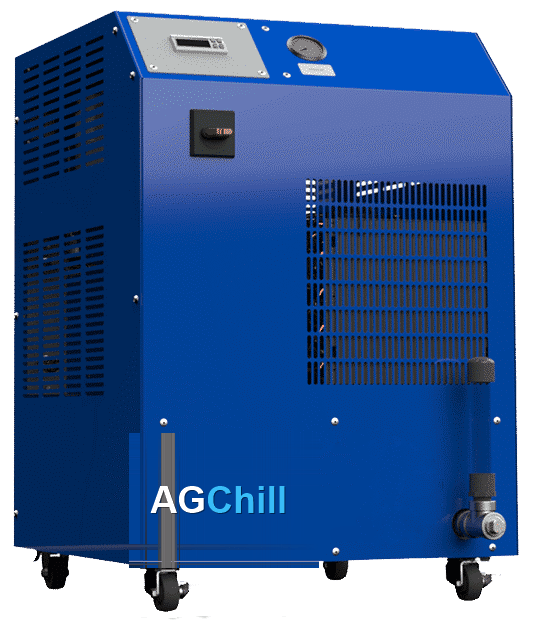
LT Series
10°F / -12°C
½ ~ 30 Ton
Low-temperature cooling for environmental simulation and specialized test applications requiring sub-ambient fluid temperatures.
Get a QuoteIn aerospace testing, a chiller failure doesn’t just stop a run — it invalidates data and threatens equipment worth millions.
If the chiller underperforms, wind tunnel data becomes unusable and test engineers must restart costly runs (often $10K–50K per session), delaying aircraft certification by weeks. Hydraulic overheating risks seal failure and loss of test rig control, creating safety hazards. Composite resin cure temperature excursions cause incomplete curing or delamination, resulting in rejected parts and schedule penalties up to $100K+.
$50K
Cost of a single invalidated wind tunnel test session
5°C
Drift that invalidates aerodynamic test data
$100K+
Penalty exposure on rejected composite parts
Whether you're researching options or ready to order, AG Chill can help.
Test engineering managers at aerospace OEMs or Tier 1 suppliers researching wind tunnel cooling, hydraulic chiller requirements, and high-reliability thermal management.
Facilities and thermal systems engineers evaluating chillers against MIL specs and lead times. Needs compliance docs, reliability data, and integration support for legacy test stands.
Plant operations directors or chief engineers preparing RFQs for new test facilities. Need delivery timeline, warranty terms, and a proven track record with similar OEMs.
Aerospace cooling is dominated by premium-priced incumbents with long lead times. AG Chill competes on agility, price, and responsiveness.
Established fluid-power brands carry deep MIL-certification pedigree and prime relationships, but ship in 16–20 weeks at a 20–30% premium. AG Chill wins on lead time and price for the same duty.
Specialty aerospace chiller makers are purpose-built and well-documented, but carry premium pricing, minimum order sizes, and a limited service footprint. AG Chill competes on value and flexibility.
Generic industrial HVAC chillers are cheap and available but not engineered for aerospace duty cycles, transient response, or contamination control. AG Chill’s application focus is the difference.
Many test facilities run 20+ year-old custom builds with no vendor support and high failure risk. AG Chill provides a modern, warrantied exit path from legacy maintenance burden.
Buying guides and technical resources for Aerospace process cooling.
Buying Guide
Thermal stability for precision machining, composite curing, and environmental test.
Read the Guide ›Sizing Guide
Heat load, flow rate, temperature differential, and ambient — how each one drives the size you actually need.
Read the Guide ›
Selection Guide
Installation, operating cost, maintenance, and application fit — which setup makes sense for your facility.
Read the Guide ›Real-world results from Aerospace customers.
We are actively documenting customer results from Aerospace installations. These will be published here as case studies are completed. Have a project to discuss? We are happy to talk through your application.
Discuss Your ApplicationTell us your target temperature, flow rate, and heat load. AG Chill will identify the right system for your Aerospace application.
For wind tunnels, environmental test chambers, hydraulic-oil cooling, and composite cure cycles that need tightly controlled temperature.
Test conditions drift out of spec, invalidating results, and hydraulic or process temperatures can exceed limits.