← All Industries
Textile Manufacturing
Textile Factory Chillers
Cooling for synthetic fiber extrusion, dye bath temperature control, loom cooling, and textile finishing processes.
View Recommended Chillers
Cooling for synthetic fiber extrusion, dye bath temperature control, loom cooling, and textile finishing processes.
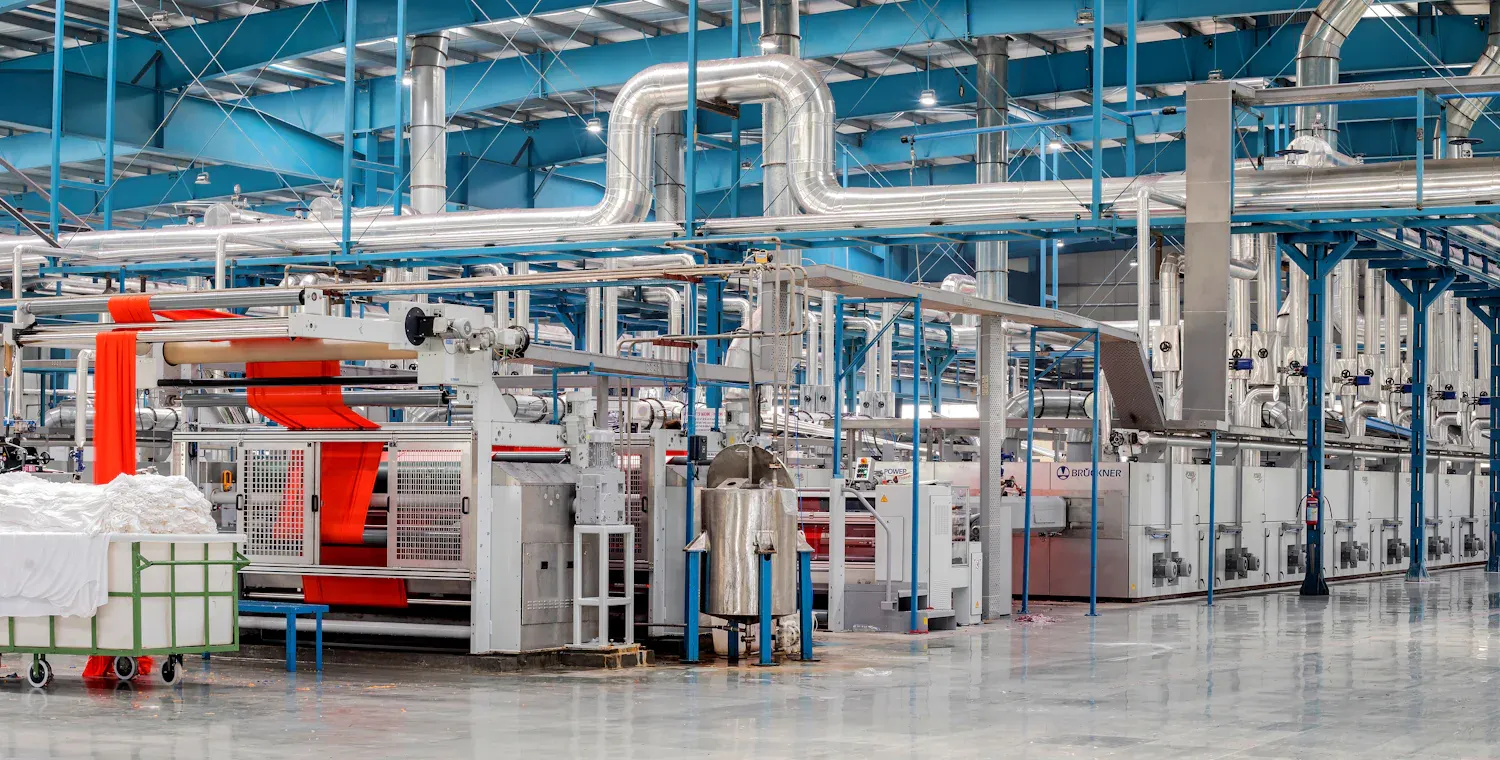
View Recommended ChillersTextile manufacturing needs both high- and low-temperature cooling. Polymer extrusion dies run at 250–300°C, and the chiller stabilizes die temperature to maintain fiber denier and crimp consistency. Dye baths require ±2–3°C control for consistent color uptake, and the chiller prevents temperature overshoot during batch cycles.
Loom cooling prevents spindle bearing overheating in high-speed weaving, and finishing equipment uses coolant loops for temperature control. Across the mill, the chiller protects both throughput and product consistency.
Common process cooling problems in Textile Manufacturing and why getting the chiller right matters.
Synthetic fiber extrusion uses very hot melt streams; the chiller must remove 200–500 kW while holding die temperature within ±3–5°C using high-temperature heat transfer fluid. Standard units aren’t rated for it.
Dye baths heat to 80–90°C then cool below 40°C in 20–40 minutes without overshoot that ruins uniformity. Undersized chillers can’t handle the ramp; oversized ones overshoot.
Dye solutions and finishing water are hard, mineral-rich, and acidic, building scale on chiller tubes and cutting efficiency. Stainless and titanium options plus water conditioning are required.
Our chillers integrate directly with the process equipment that Textile Manufacturing relies on. These are the systems we most often cool — each with its own temperature target, flow, and failure mode we size for.
The chiller cools the quench and godets that set fiber structure.
The chiller runs the controlled cool-down that fixes color.
The chiller holds roller and cure temperatures for consistent finish.
Chiller systems most commonly matched to Textile Manufacturing applications.
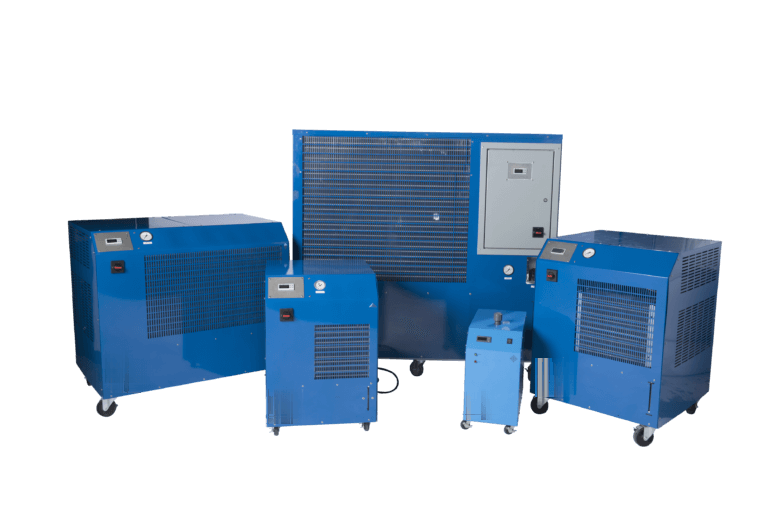
Standard Series
40°F / 4°C
1/3-40 Ton
Process cooling for fiber extrusion and finishing equipment with high-temperature fluid compatibility and corrosion-resistant materials.
Get a QuoteCentral Chiller
45°F / 7°C
10-50 Ton
Centralized cooling for mills running extrusion, dye, and finishing loads simultaneously.
Get a Quote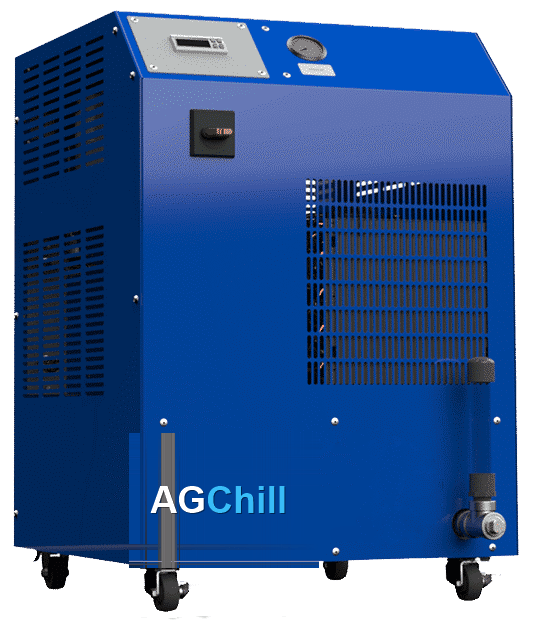
LT Series
10°F / -12°C
½ ~ 30 Ton
Low-temperature cooling for rapid dye-cycle quenching and processes requiring sub-ambient fluid.
Get a QuoteIn a textile mill, a cooling failure scraps fiber and fabric by the batch.
Extrusion chiller failure lets die temperature rise 10°C; polymer viscosity drops, fiber tenacity and elongation degrade, and QC rejects the batch — $100K–500K per day of production. Dye bath chiller failure causes a temperature excursion; color matching fails across the batch and thousands of meters must be re-dyed, costing weeks and $200K–1M. Loom bearing overheating spikes scrap and forces unplanned downtime.
$500K/day
Production lost to a fiber extrusion cooling failure
$1M
Re-dye cost from a dye bath temperature excursion
±3°C
Die temperature stability extrusion requires
Whether you're researching options or ready to order, AG Chill can help.
Production managers and process engineers at textile manufacturers researching fiber extrusion cooling, dye bath temperature control, and textile process chillers.
Maintenance managers comparing options for a process upgrade — evaluating high-temperature capability, dye-cycle ramp performance, and corrosion resistance.
Plant operations directors in the RFQ phase for a new line. Need process-integration validation, fiber/dye-specific thermal modeling, and a 5-year warranty.
Textile cooling is bundled by machinery OEMs or premium-priced. AG Chill brings regional availability and competitive pricing.
Textile-machinery OEMs integrate cooling into extrusion/dye equipment with proprietary, dealer-tied service. AG Chill captures aftermarket and independent textile operations.
Outdoor-rated industrial chiller makers perform well in dyehouses but at a premium with limited availability in textile regions. AG Chill’s footprint and pricing appeal to cost-conscious mills.
The aftermarket is full of units with corrosion/wear risk and no warranty. AG Chill’s reliability makes new equipment compelling for critical processes.
Custom solutions at large mills carry high engineering cost and support burden. AG Chill’s turnkey approach reduces operational risk.
Buying guides and technical resources for Textile Manufacturing process cooling.
Buying Guide
Cooling for synthetic-fiber extrusion, dyeing, and spinning-hall humidity.
Read the Guide ›Sizing Guide
Heat load, flow rate, temperature differential, and ambient — how each one drives the size you actually need.
Read the Guide ›
Selection Guide
Installation, operating cost, maintenance, and application fit — which setup makes sense for your facility.
Read the Guide ›Real-world results from Textile Manufacturing customers.
We are actively documenting customer results from Textile Manufacturing installations. These will be published here as case studies are completed. Have a project to discuss? We are happy to talk through your application.
Discuss Your ApplicationTell us your target temperature, flow rate, and heat load. AG Chill will identify the right system for your Textile Manufacturing application.
For injection molding, synthetic-fiber extrusion, and dye-bath temperature control.
Off-shade and inconsistent results, plus extrusion problems, causing rejects.