← All Industries
Horticulture & Agriculture
Horticulture & Agriculture Chillers
Greenhouse climate control, hydroponic nutrient solution cooling, and post-harvest cold storage support.
View Recommended Chillers
Greenhouse climate control, hydroponic nutrient solution cooling, and post-harvest cold storage support.
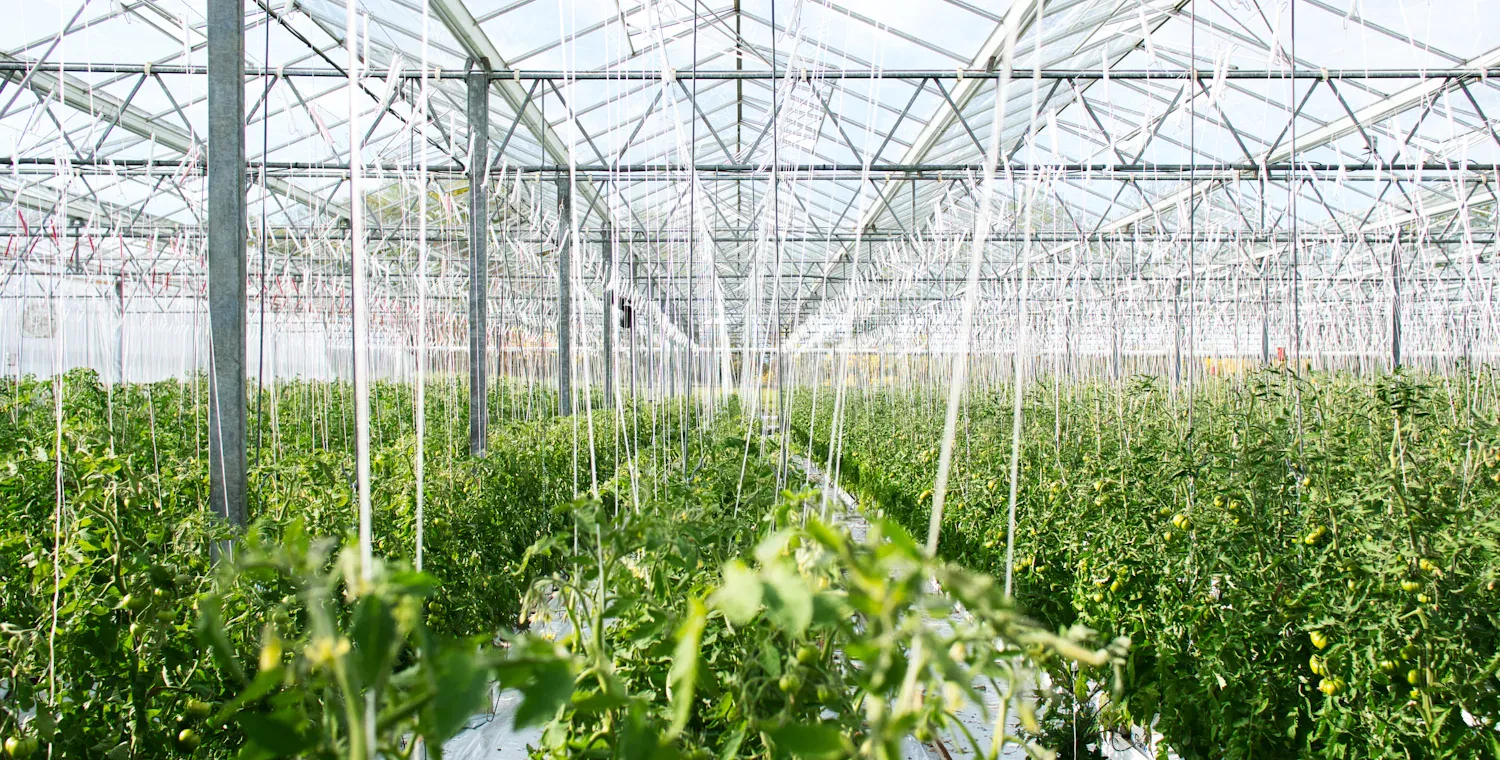
View Recommended ChillersModern horticulture uses chilled water or glycol for greenhouse climate control, hydroponic nutrient cooling, and post-harvest cold storage. Greenhouse cooling prevents heat stress during peak season; hydroponic systems need 18–22°C solution temperature to support root growth and nutrient uptake while preventing algae and pathogens.
Cold storage facilities hold 0–5°C to protect harvested produce. Across the operation, the chiller protects crop yield and product shelf life directly tied to revenue.
Common process cooling problems in Horticulture & Agriculture and why getting the chiller right matters.
Cooling demand swings from 500+ kW in summer to 50 kW in spring/fall. The chiller must modulate efficiently across this range without constant cycling that wastes energy and wears the compressor.
Greenhouse systems face near-100% humidity and fertilizer salt spray that corrodes standard steel in 2–3 years. Stainless or epoxy-coated construction and fluid compatibility are essential.
Facilities combine fog/evaporative cooling with chiller-supported spray systems. The chiller control must integrate with fog controllers and refrigeration compressors in multi-stage architectures.
Our chillers integrate directly with the process equipment that Horticulture and Agriculture relies on. These are the systems we most often cool — each with its own temperature target, flow, and failure mode we size for.
The chiller chills nutrient solution to protect roots and dissolved oxygen.
The chiller supplies cooling for tight day/night temperature control.
The chiller pulls field heat and hold produce at storage temperature.
Chiller systems most commonly matched to Horticulture & Agriculture applications.
Standard Series
40°F / 4°C
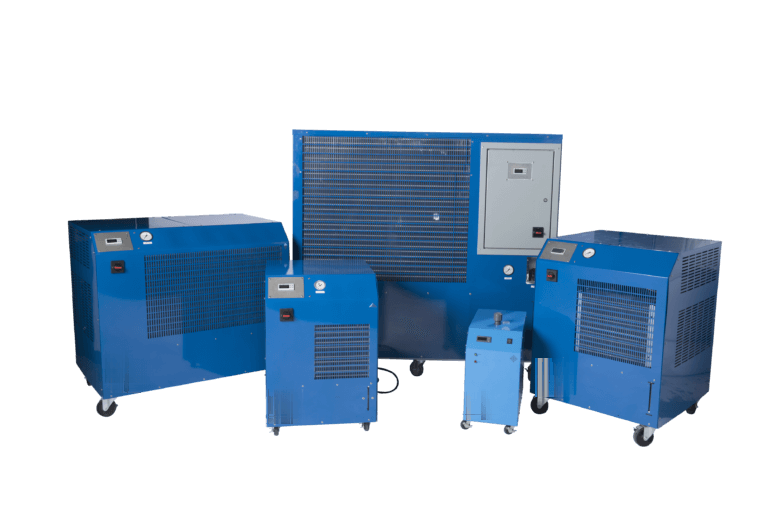
1/3-40 Ton
Process cooling for greenhouse climate systems and hydroponic nutrient solution with corrosion-resistant construction.
Get a QuoteCentral Chiller
45°F / 7°C
10-50 Ton
High-capacity centralized cooling for large greenhouse facilities and post-harvest cold storage operations.
Get a Quote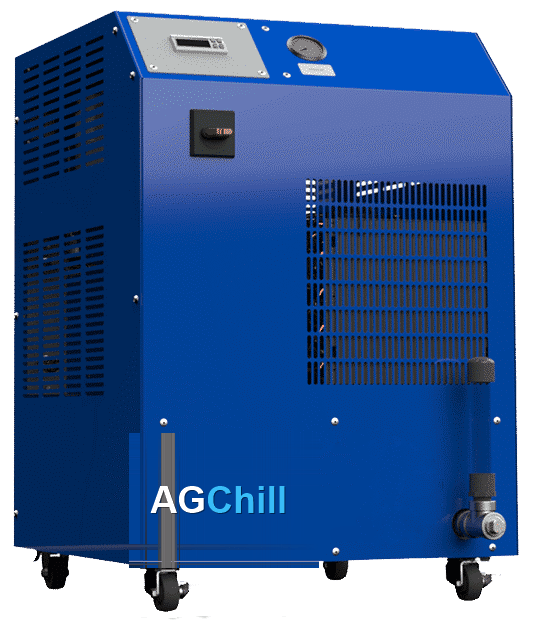
LT Series
10°F / -12°C
½ ~ 30 Ton
Low-temperature cooling for cold storage and post-harvest applications requiring sub-ambient control.
Get a QuoteIn horticulture, a cooling failure during a heat spike can wipe out an entire crop.
Greenhouse chiller failure during a heat spike pushes temperature past 35°C; heat-sensitive crops wilt, drop flowers, and develop necrosis — crop loss of 20–50% on a large greenhouse, or $100K–500K. Hydroponic chiller failure warms the nutrient solution, triggering algae blooms and root disease that cascade into harvest loss. Cold storage cooling failure at peak season risks spoiling entire inventory worth $500K–5M.
$5M
Inventory at risk in a cold storage cooling failure
20–50%
Crop loss from a greenhouse heat excursion
18–22°C
Hydroponic solution temperature target
Whether you're researching options or ready to order, AG Chill can help.
Greenhouse managers and horticulture leads at commercial greenhouses, nurseries, or vertical farms researching greenhouse cooling, hydroponic nutrient cooling, and cold storage.
Facilities managers comparing options for a new structure or upgrade — evaluating seasonal load handling, corrosion resistance, and climate-control integration.
Ag operations directors planning expansion. Need crop- and climate-specific thermal modeling, hybrid cooling integration proof, and financing aligned with agricultural cycles.
Horticultural cooling is bundled by greenhouse OEMs or handled by generic units. AG Chill is purpose-built for the ag environment.
Greenhouse-equipment OEMs integrate climate control including cooling, but bundle it into larger systems at premium pricing. AG Chill captures standalone and retrofit cooling.
Generic industrial chiller suppliers are available but not optimized for the corrosive ag environment, with poor part-load modulation and inadequate humidity tolerance. AG Chill’s ag-focused design outperforms.
On-site custom builds vary in quality and reliability and depend on the local contractor for support. AG Chill’s engineered, warrantied solution provides consistency.
Fog and evaporative cooling alone are weather-dependent, water-hungry, and incomplete. AG Chill’s integrated approach provides reliable thermal control.
Buying guides and technical resources for Horticulture & Agriculture process cooling.
Buying Guide
How nutrient-water temperature controls root health and dissolved oxygen.
Read the Guide ›Sizing Guide
Heat load, flow rate, temperature differential, and ambient — how each one drives the size you actually need.
Read the Guide ›
Selection Guide
Installation, operating cost, maintenance, and application fit — which setup makes sense for your facility.
Read the Guide ›Real-world results from Horticulture & Agriculture customers.
We are actively documenting customer results from Horticulture & Agriculture installations. These will be published here as case studies are completed. Have a project to discuss? We are happy to talk through your application.
Discuss Your ApplicationTell us your target temperature, flow rate, and heat load. AG Chill will identify the right system for your Horticulture & Agriculture application.
They cool greenhouse climate, hydroponic nutrient solutions, fermentation, and post-harvest cold storage.
Nutrient and root-zone temperatures move out of range and post-harvest product degrades faster.