← All Industries
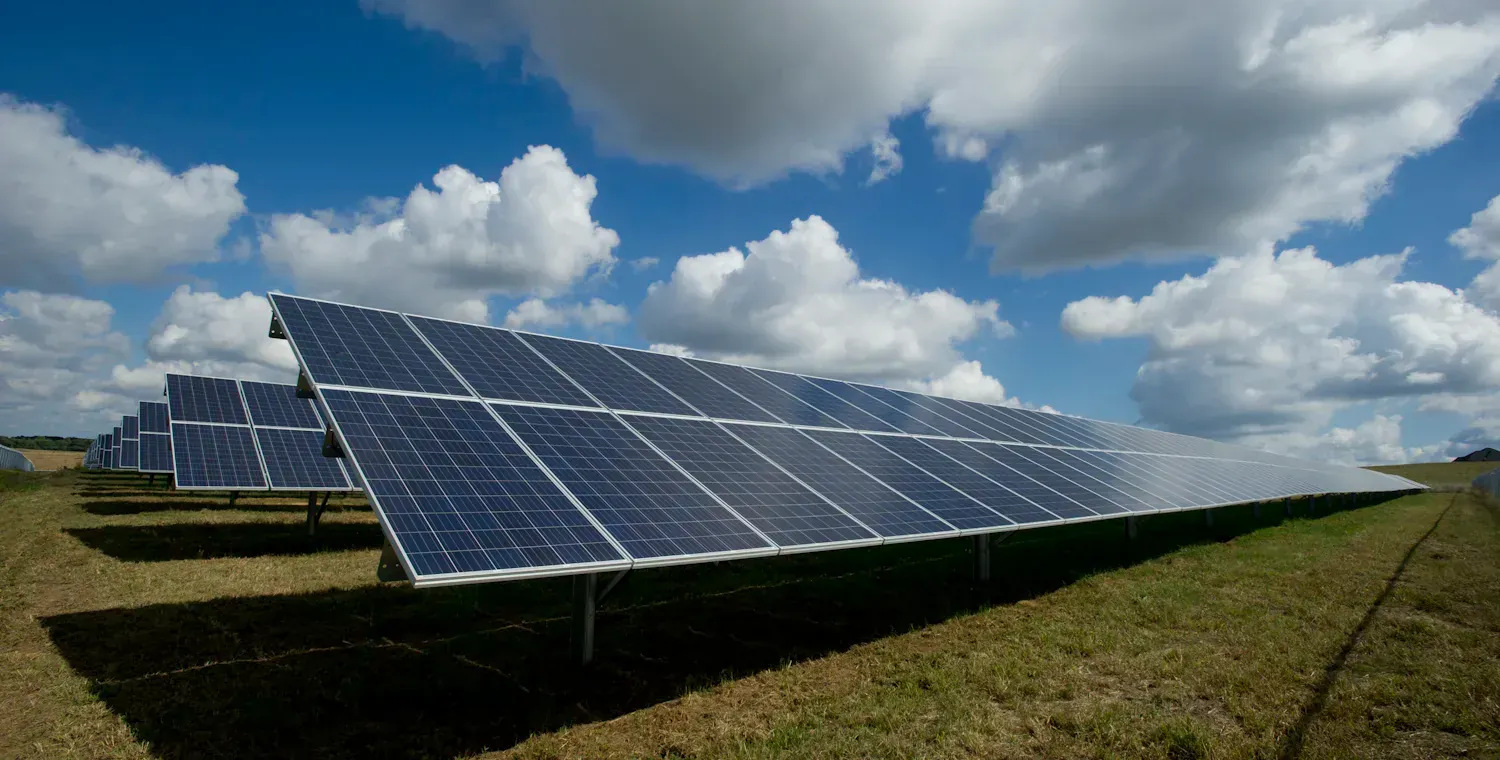
Alternative Energy
Alternative Energy Chillers
Cooling for solar panel manufacturing, battery production and testing, wind turbine component testing, and fuel cell development.
View Recommended Chillers
Cooling for solar panel manufacturing, battery production and testing, wind turbine component testing, and fuel cell development.
View Recommended ChillersSolar and battery manufacturing, wind turbine testing, and fuel cell development all depend on precise cooling for both processes and equipment. Solar lamination requires temperature-controlled press platens; battery manufacturing needs cold electrolyte storage and cooling during charge/discharge testing; wind gearbox testing demands sustained cooling of 200+ kW friction loads.
These are fast-moving R&D and scaling environments where cooling downtime cascades directly into delayed product development and lost manufacturing output.
Common process cooling problems in Alternative Energy and why getting the chiller right matters.
Wind gearbox benches, fuel cell stack rigs, and battery cycling equipment generate 200–500 kW sustained. Undersized chillers force reliance on auxiliary cooling towers that complicate control.
Solar lamination uses high-temperature thermal oils; battery testing uses low-conductivity electrolytes; hydrogen cooling needs special sealing. Standard chillers aren’t rated for these fluids.
Aggressive timelines mean cooling downtime delays product development and stops manufacturing at 1–2% of monthly revenue per day. Redundancy and 24/7 support are non-negotiable.
Our chillers integrate directly with the process equipment that Alternative Energy relies on. These are the systems we most often cool — each with its own temperature target, flow, and failure mode we size for.
The chiller holds cells at setpoint through charge/discharge cycling.
The chiller supplies the cold side for cell and module qualification.
The chiller controls lamination temperature for consistent module bonding.
The chiller manages stack and coolant-loop temperature during testing.
Chiller systems most commonly matched to Alternative Energy applications.
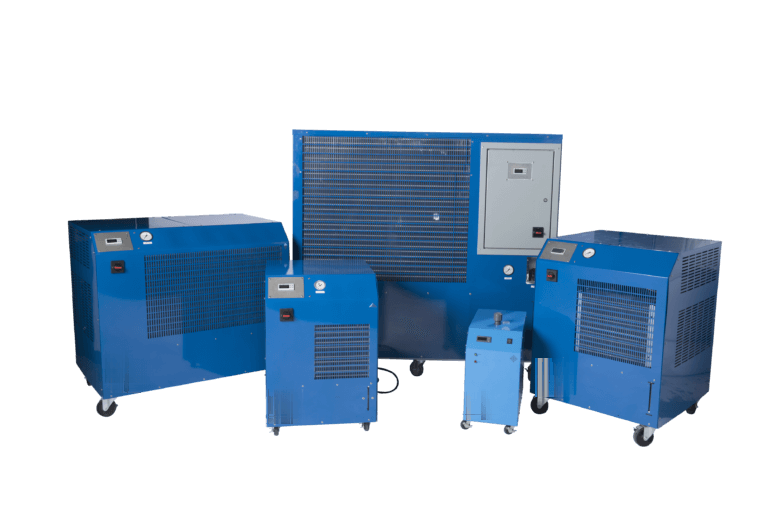
Standard Series
40°F / 4°C
1/3-40 Ton
Process cooling for solar lamination, battery production lines, and component testing with specialty-fluid compatibility.
Get a Quote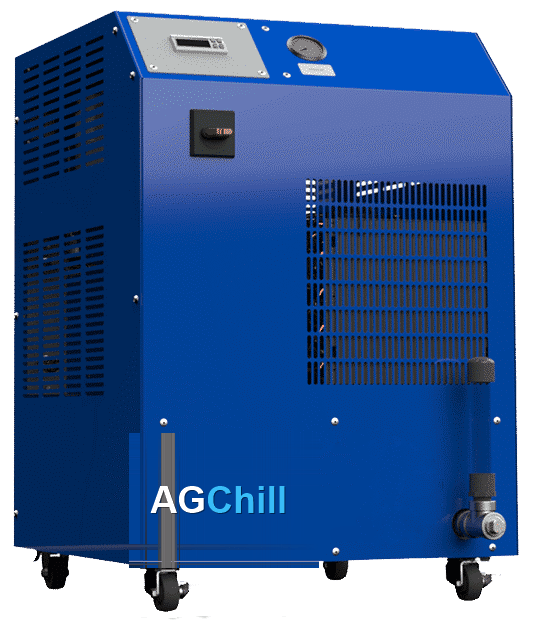
LT Series
10°F / -12°C
½ ~ 30 Ton
Low-temperature cooling for battery electrolyte storage and charge/discharge testing requiring sub-ambient control.
Get a QuoteCentral Chiller
45°F / 7°C
10-50 Ton
High-capacity centralized cooling for wind turbine and fuel cell test facilities with sustained high heat loads.
Get a QuoteIn alternative energy, a cooling failure shows up as field warranty claims years later — or scrapped batches today.
Solar lamination chiller failure lets platen temperature drift; encapsulant cures unevenly, trapping bubbles and weakening modules. Field failures spike 2–3 years later, with modules degrading 5–15% and triggering warranty claims of $100K–1M+. Battery electrolyte cooling failure degrades cell performance and scraps batches worth $500K+. A wind gearbox test abort delays product launch by weeks at $1M+ in lost time-to-market.
$1M+
Warranty exposure from solar lamination defects
$500K
Value of a scrapped battery production batch
200–500 kW
Sustained test-bench heat loads
Whether you're researching options or ready to order, AG Chill can help.
Process engineers at renewable equipment manufacturers researching battery thermal management, solar lamination cooling, and high-temperature thermal oil chillers.
Facilities managers comparing solutions for a new line or test facility — evaluating fluid compatibility, capacity, redundancy, and cost of cooling per kWh.
Plant directors planning facility scale-up. Need process-specific thermal validation, 24/7 support, a warranty aligned with a 5–10 year ramp, and financing options.
Energy-sector cooling is conservative and premium-priced. AG Chill is agile with specialty fluids and faster to deploy.
Energy-sector specialists renewable divisions have brand trust but are conservative with non-standard fluids and slow on custom engineering. AG Chill’s agility with specialty fluids is an advantage.
Thermal-oil chiller specialists build for 120–200°C operation but at a premium with high minimums and limited battery/hydrogen expertise. AG Chill’s broader application range gives it an edge.
Generic industrial chiller suppliers are cheap but not optimized for high-temperature fluids or test duty, with poor transient response for cycling tests. AG Chill’s test-specific design outperforms.
Custom systems at startups and universities are unreliable with no vendor support. AG Chill offers turnkey reliability to support scaling from lab to factory.
Buying guides and technical resources for Alternative Energy process cooling.
Buying Guide
Precise cooling for battery cell production and cycle-life testing, solar, and power electronics.
Read the Guide ›Sizing Guide
Heat load, flow rate, temperature differential, and ambient — how each one drives the size you actually need.
Read the Guide ›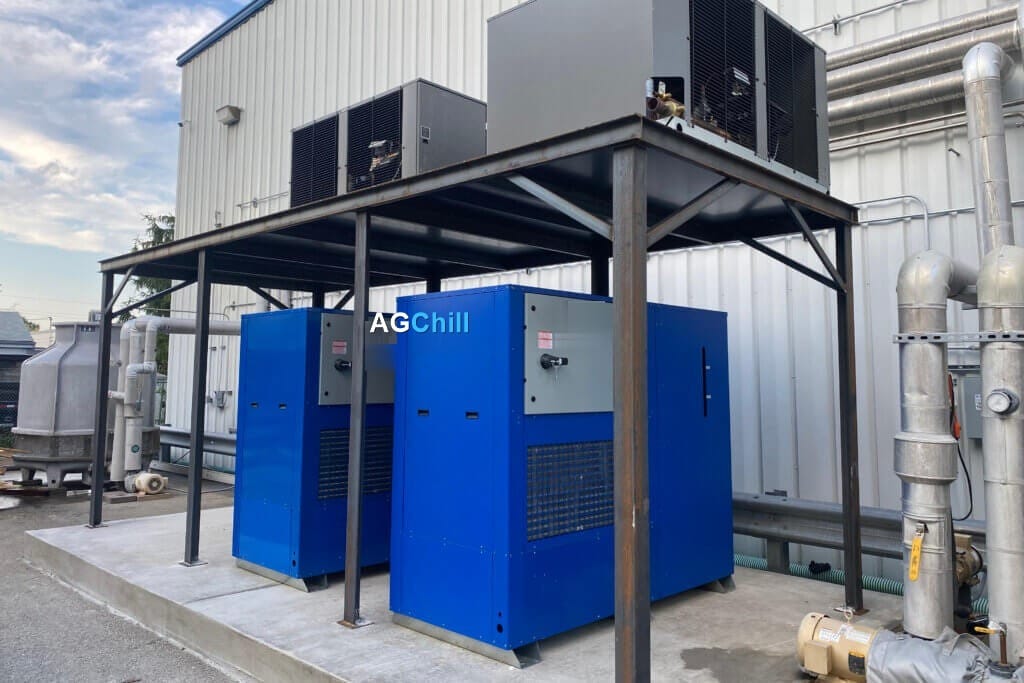
Selection Guide
Installation, operating cost, maintenance, and application fit — which setup makes sense for your facility.
Read the Guide ›Real-world results from Alternative Energy customers.
We are actively documenting customer results from Alternative Energy installations. These will be published here as case studies are completed. Have a project to discuss? We are happy to talk through your application.
Discuss Your ApplicationTell us your target temperature, flow rate, and heat load. AG Chill will identify the right system for your Alternative Energy application.
They cool solar lamination, battery environmental chambers, wind-turbine and fuel-cell test stands, and energy-storage systems.
Battery cells can overheat or fall out of their safe window, lamination goes off-spec, and test data is invalidated.