← All Industries
Automotive
Automotive Manufacturing Chillers
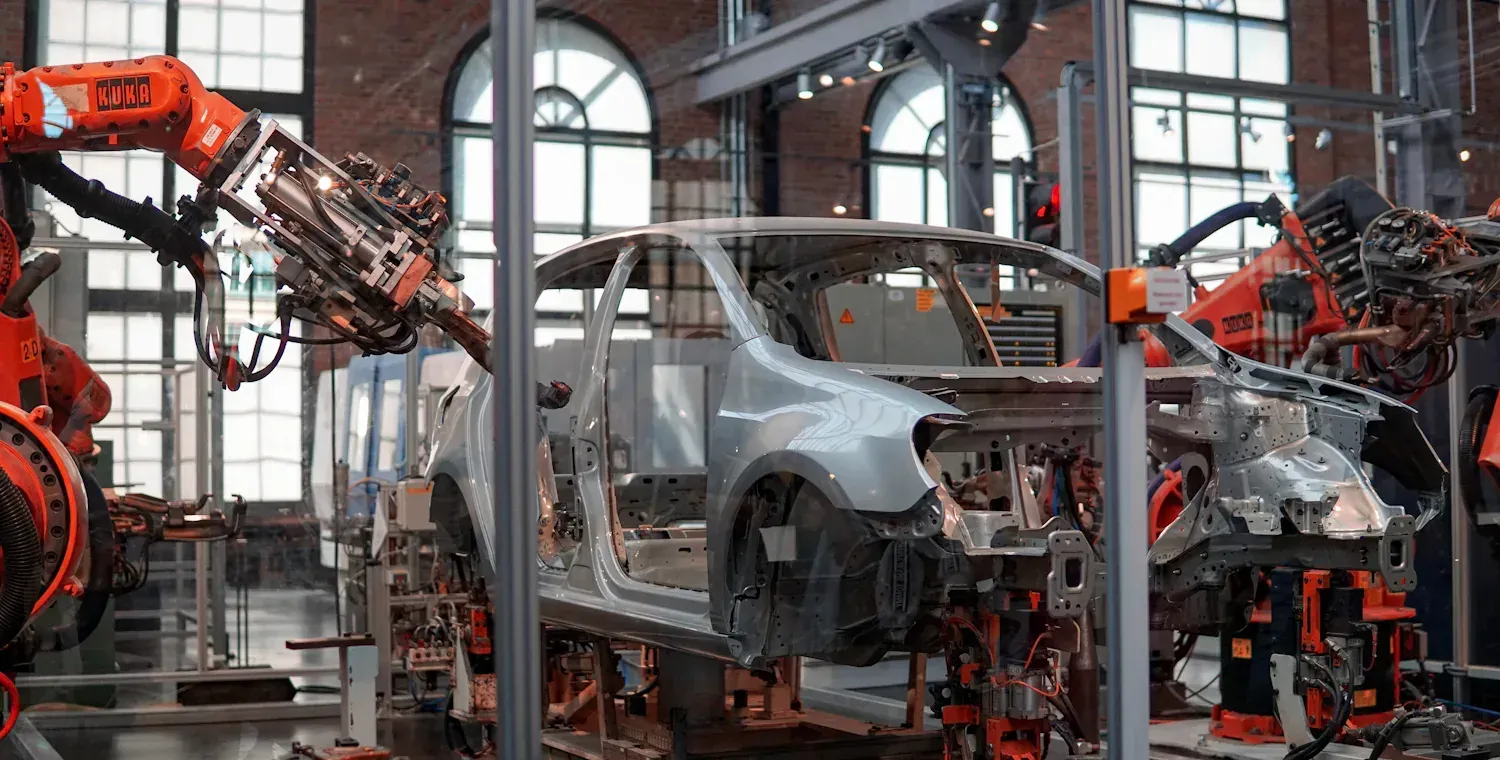
Paint booth cooling, welding equipment cooling, powertrain test cell cooling, and assembly line fixture thermal management.
View Recommended Chillers
Paint booth cooling, welding equipment cooling, powertrain test cell cooling, and assembly line fixture thermal management.
View Recommended ChillersAutomotive manufacturing demands precise, uninterrupted cooling across paint booths, welding equipment, engine, powertrain, and EV battery test cells, and assembly fixtures. Paint booth chillers stabilize air temperature within ±2°C to ensure coating cure rates; test cell chillers absorb 500+ kW during dyno runs to prevent bearing and seal overheating.
Hydraulic and laser systems on the assembly line also need tight thermal control for dimensional accuracy and durability. With lines running two or three shifts, the chiller must deliver this without interruption.
Common process cooling problems in Automotive and why getting the chiller right matters.
Assembly lines and test cells run continuously for 16–24 hours daily with zero downtime tolerance. Hermetic compressors often fail before 20,000 hours in this duty; industrial-grade compressors are essential.
Paint booth (22°C), dynamometer (15°C), welding hydraulics (35°C), and assembly fixtures all run from one facility chiller. Multi-zone control saves footprint versus stacking separate units.
High-mineral well water fouls chiller tubes and cuts efficiency; closed-loop inhibitors degrade over time. The chiller needs integrated water-quality monitoring most generic units lack.
Our chillers integrate directly with the process equipment that Automotive relies on. These are the systems we most often cool — each with its own temperature target, flow, and failure mode we size for.
The chiller rejects heat from engine and e-motor test cells.
The chiller stabilizes process and rinse temperatures.
The chiller cools molds for consistent part quality and cycle time.
The chiller cools weld guns, transformers, and servo drives.
Chiller systems most commonly matched to Automotive applications.
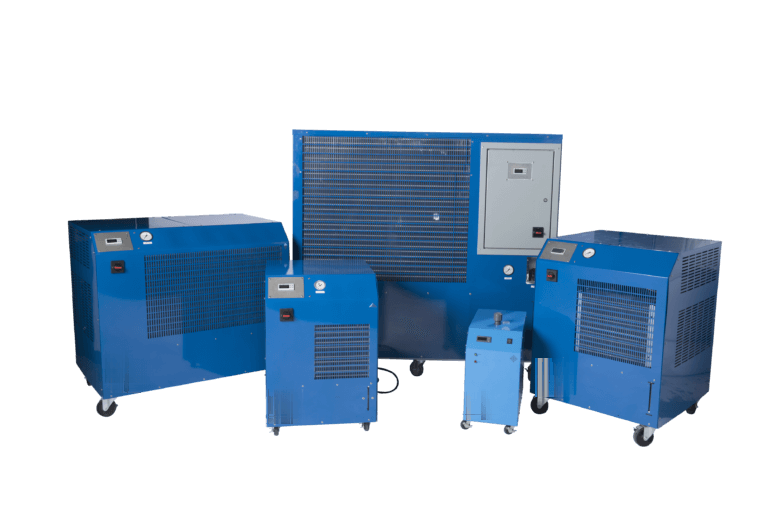
Central Chiller
45°F / 7°C
10-50 Ton
Centralized multi-zone cooling for paint booths, test cells, and assembly systems running on independent setpoints from one system.
Get a QuoteStandard Series
40°F / 4°C
1/3-40 Ton
Industrial-duty process cooling for welding equipment, hydraulics, and laser systems in continuous-duty assembly operations.
Get a Quote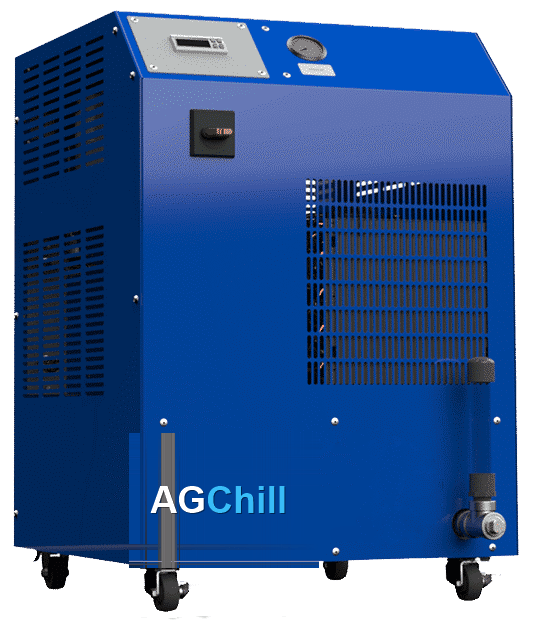
LT Series
10°F / -12°C
½ ~ 30 Ton
Low-temperature cooling for powertrain test cells and specialized processes requiring sub-ambient fluid temperatures.
Get a QuoteOn an automotive line, cooling loss means defective vehicles and ruined prototypes — fast.
Paint booth chiller failure causes a temperature excursion; paint cure is compromised, producing sags, runs, and adhesion defects across 50–200 vehicles before detection — rework at $2K–5K per vehicle. Test cell chiller failure aborts a run and can destroy a $500K–2M prototype. Welding robot chiller malfunction degrades spot quality, forcing a line shutdown and scrap of hundreds of vehicle shells.
$500K
Rework cost from a paint booth cure failure
$2M
Prototype lost to a test cell cooling failure
24/7
Uptime demand on automotive line cooling
Whether you're researching options or ready to order, AG Chill can help.
Plant maintenance managers and facilities engineers at automotive OEMs or Tier 1 suppliers researching paint booth cooling, test cell chillers, and 24/7 industrial cooling.
Thermal systems leads comparing solutions for a line expansion — evaluating capacity, multi-zone capability, uptime SLA, and energy efficiency.
Plant operations directors in the RFQ phase for a facility upgrade. Need infrastructure integration, a 5-year production warranty, 24/7 service, and OEM references.
Automotive cooling is held by premium HVAC incumbents and OEM-specific suppliers. AG Chill competes on cost and responsiveness.
Large HVAC incumbents have proven uptime and OEM relationships, but high cost, slow custom response, and oversized legacy systems. AG Chill wins on cost and agility.
Dedicated automotive cooling suppliers pre-validate for paint booths and test cells but at premium pricing, long lead times, and OEM lock-in. AG Chill is independent and more responsive.
Rental cooling companies deploy fast with no capex, but rental cost over 3–5 years exceeds purchase and uptime guarantees fall short. AG Chill’s capital cost wins on amortized TCO.
Groundwater and evaporative cooling are weather-dependent with poor part-load control. AG Chill’s all-in-one design eliminates infrastructure dependencies.
Buying guides and technical resources for Automotive process cooling.
Buying Guide
Cooling across weld, die casting, paint, and EV battery cell production and testing.
Read the Guide ›Sizing Guide
Heat load, flow rate, temperature differential, and ambient — how each one drives the size you actually need.
Read the Guide ›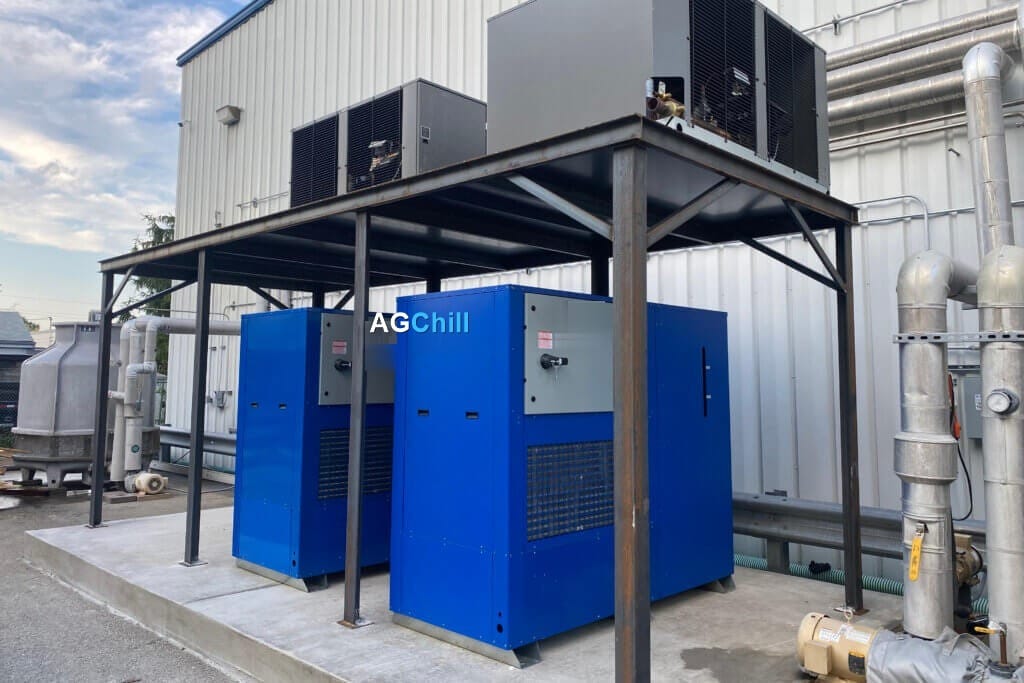
Selection Guide
Installation, operating cost, maintenance, and application fit — which setup makes sense for your facility.
Read the Guide ›Real-world results from Automotive customers.
We are actively documenting customer results from Automotive installations. These will be published here as case studies are completed. Have a project to discuss? We are happy to talk through your application.
Discuss Your ApplicationTell us your target temperature, flow rate, and heat load. AG Chill will identify the right system for your Automotive application.
Injection molding, hydraulic-oil cooling, paint-booth conditioning, and powertrain test cells all rely on process chillers.
Molded and painted parts vary, and test-cell conditions fall out of spec, causing rework and inconsistent results.