
← All Industries
Surface Finishing & Anodizing
Surface Finishing & Anodizing Chillers
Precise, corrosion-resistant bath cooling for anodizing, electroplating, and metal finishing — holding coating quality run after run.
View Recommended Chillers
Precise, corrosion-resistant bath cooling for anodizing, electroplating, and metal finishing — holding coating quality run after run.
View Recommended ChillersPlating and anodizing are temperature-controlled chemistry. Hard-coat and sulfuric anodizing generate significant heat at the part, and the bath has to be held cold — often near 0–10°C for hard anodize, around 20°C for standard — or the coating comes out soft, burnt, or off-spec. Electroplating baths (nickel, chrome, zinc, copper) and the rectifiers driving them add their own heat that must be removed to hold deposition rate and finish.
At these tolerances the chiller is part of the process spec: a few degrees of bath drift changes coating thickness, hardness, color, and adhesion — the difference between a passing part and a stripped-and-reworked one.
Common process-cooling problems in surface finishing — and why getting the chiller right protects the coating and the bath.
Anodizing (especially hard-coat) and precision plating need the bath held within a narrow window while the process dumps heat into it. Too warm and the coating burns, softens, or loses thickness — this needs real capacity and stable control, not a loosely-cycling unit.
Sulfuric and chromic acids, caustics, and plating salts are hard on equipment. The chiller loop that touches the bath needs corrosion-resistant wetted materials and the right heat exchanger — a standard steel loop won't survive.
The DC rectifiers driving plating and anodizing lines throw off substantial heat of their own. Many shops cool the rectifiers on the same chilled loop, so the system has to carry both the bath load and the power-supply load together.
Our chillers integrate directly with the finishing line. These are the systems we most often cool — each with its own temperature target, chemistry, and failure mode we size for.
The chiller holds the anodize bath cold and stable so coating hardness and thickness stay in spec.
The chiller controls nickel, chrome, zinc, and copper bath temperature for consistent deposition and finish.
The chiller carries the DC rectifier heat load so the power supply runs cool and reliable.
Chiller systems most commonly matched to surface-finishing applications.
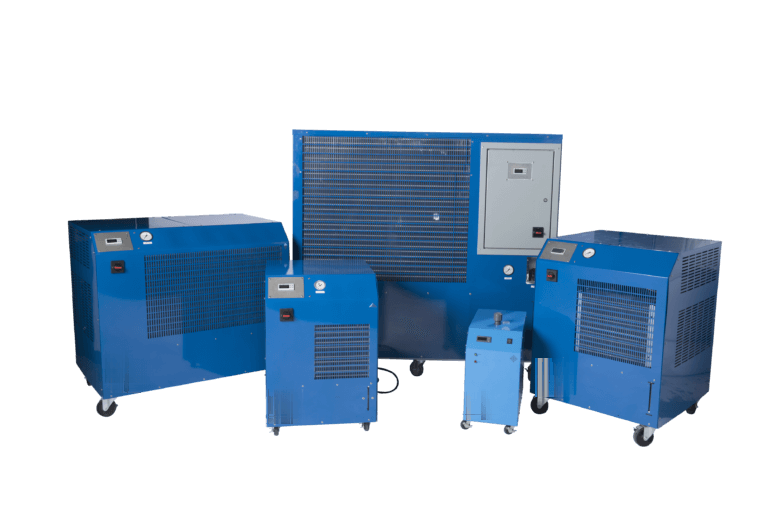
Standard Series
55°F / 13°C
1/3-40 Ton
Stable bath and rectifier cooling for standard anodizing and plating lines, with corrosion-resistant wetted-material options for aggressive chemistry.
Get a Quote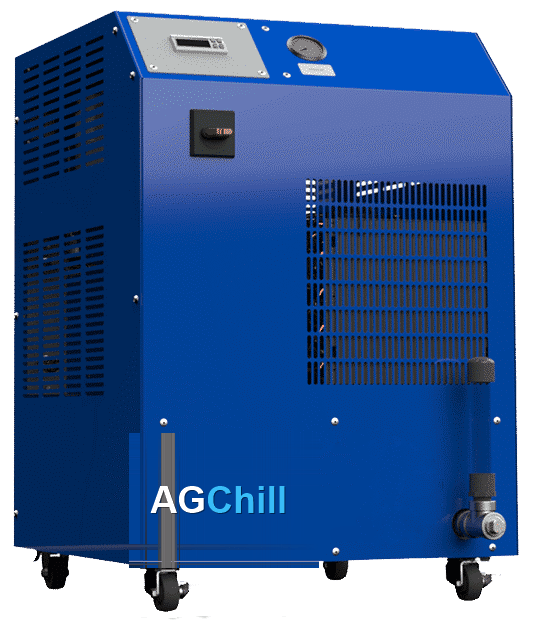
LT Series
32°F / 0°C
½ ~ 30 Ton
Near-freezing bath cooling for hard-coat anodizing and processes that must run cold to hold coating hardness and thickness.
Get a QuoteCentral Chiller
Line-wide
5-50 Ton
Plant-wide cooling for a full finishing line — multiple tanks and rectifiers on one corrosion-resistant loop, sized with capacity margin.
Get a QuoteWhen the bath warms, the coating goes off-spec and the parts get stripped and reworked.
Let an anodize bath warm past its window and the coating comes out soft, burnt, powdery, or under-thickness — whole racks fail hardness and thickness checks and have to be stripped and re-run, doubling the cost and the lead time. Plating baths drift out of their deposition window and finish, color, and adhesion suffer. Overheated rectifiers fault or fail outright, taking the line down. On top of it, running a bath hot accelerates chemistry breakdown and drag-out, driving up chemical cost. The chiller is the cheapest way to protect a rack of high-value parts.
0–10°C
Bath window hard-coat anodizing demands
Strip & redo
Fate of a rack coated in an off-temp bath
Line down
When the rectifier overheats and faults
Whether you're researching options or ready to order, AG Chill can help.
Process and plating engineers at anodizers and finishing job shops researching bath chiller sizing, corrosion-resistant loops, and how to hold hard-coat temperature.
Plant managers evaluating a chiller replacement — needs bath capacity, wetted-material compatibility, rectifier load, and parts availability.
Operations or quality leads in the RFQ phase. Need bath-temperature validation, corrosion-resistant build, and commissioning on a specific finishing line.
Finishing-line cooling is split between costly specialists and generic units that ignore the chemistry. AG Chill balances precision, corrosion resistance, and cost.
Line OEMs bundle chillers with proprietary design and dealer-only support. AG Chill wins retrofits and independent shops that want corrosion-ready cooling without the lock-in.
Specialty cooling houses handle aggressive chemistry well but at a steep premium and long lead times. AG Chill delivers the corrosion-resistant build at industrial capacity and cost.
Generic units are cheaper but ignore wetted-material compatibility and hold only ±3–5°C — risking the bath and the parts. AG Chill's corrosion-ready, precise build is the difference.
Second-hand units carry unknown corrosion history and no warranty on the loop protecting an expensive bath. AG Chill's new-build reliability removes that risk.
Buying guides and technical resources for surface-finishing process cooling.
Sizing Guide
Heat load, flow rate, temperature differential, and ambient — how each one drives the size your finishing line needs.
Read the Guide ›
Finishing Guide
Hard-coat bath temperatures, where the heat comes from, corrosion-resistant cooling, and sizing for the rectifier load.
Read the Guide ›
Related Industry
Finishing baths are aggressive chemistry — see how we handle corrosion-resistant process cooling.
View Industry ›Real-world results from surface-finishing customers.
We are actively documenting customer results from surface-finishing installations. These will be published here as case studies are completed. Have a project to discuss? We are happy to talk through your application.
Discuss Your ApplicationTell us your bath, target temperature, and rectifier load. AG Chill will identify the right corrosion-resistant system for your finishing line.
Anodizing and plating baths are exothermic and temperature-sensitive; the chiller holds the bath at the exact temperature that controls coating quality, often with corrosion-resistant construction.
Coating quality, hardness, and color go off-spec, causing rejects and rework.